
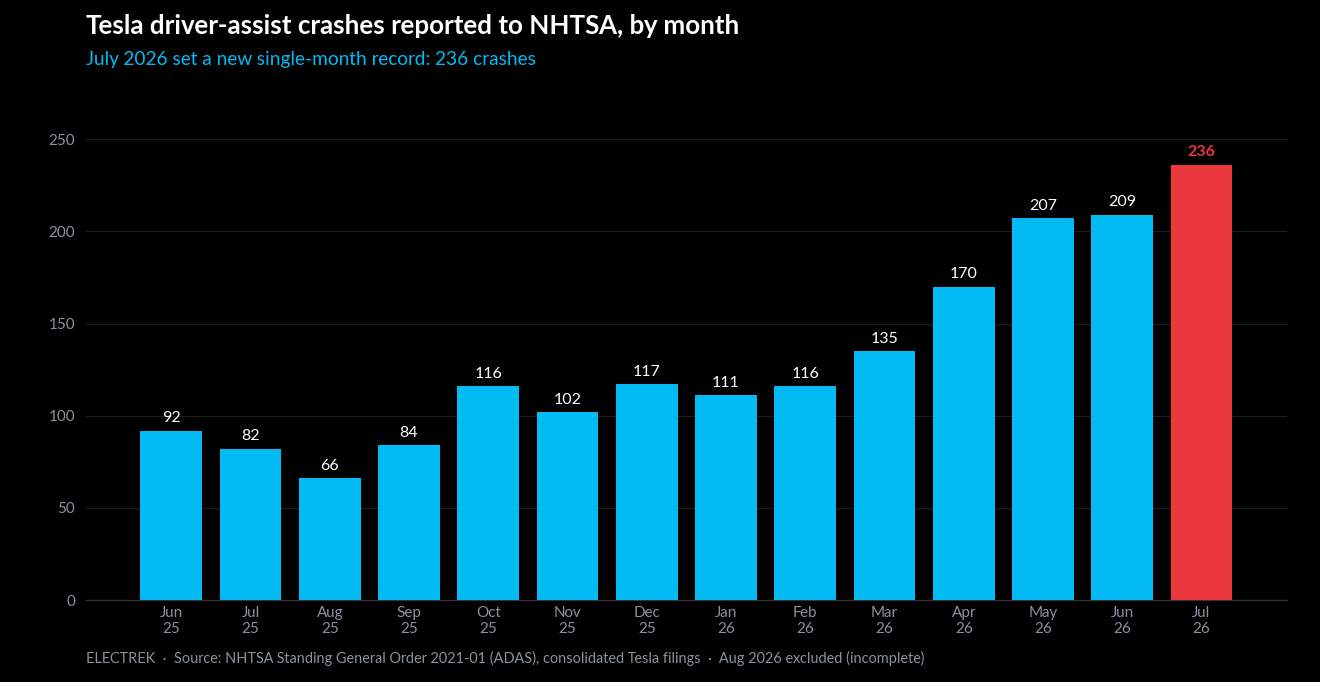
July 2026 was the worst month on record for Tesla driver-assist crashes. Tesla reported 236 of them to federal regulators, the most it has ever filed in a single month.
Four of those crashes killed someone. In every one, Tesla’s own data says Autopilot or “Full Self-Driving” was engaged, and in every one, the public was never told the system was involved. This is the latest from our ongoing investigation matching Tesla’s redacted NHTSA reports to real, named crashes.
A record month, and a rising line
Under a 2021 NHTSA Standing General Order, automakers must report crashes where a Level 2 driver-assist system was engaged within 30 seconds of impact. Tesla’s monthly count has climbed all year, from 135 in March to 207 in May to 209 in June. July’s 236 is a new high.
Seven deaths, four sealed reports
Each of these appears in Tesla’s July filings, each marked “Verified Engaged” — meaning Tesla confirmed through its telematics that the system was on. And on each one, Tesla redacted the three fields that would explain the crash: the narrative, the software version, and whether the road was within the system’s approved operating area.
At Electrek, we matched the non-redacted facts about each crash to public reports to better understand each one, since Tesla is trying to limit the information.
Upper Marlboro, Maryland. Around 12:45 a.m. on July 12, a Tesla Model 3 making a left turn onto Governor’s Park Lane off Route 301 failed to yield to a Harley-Davidson going straight, Maryland State Police said. Three people died: the motorcyclist, Matthew Vowell, 48; his passenger, Krystal Vowell, 47; and a passenger inside the Tesla, Adriana Maxwell, 22. The Tesla was operating as a rideshare. Tesla’s report logs a left turn at 20 mph, driver-assist verified engaged, and says it holds the video. An unprotected left turn across oncoming traffic is a City-Streets maneuver, the kind of thing FSD does and basic Autopilot cannot, the same failure mode as the Batavia crash we documented.
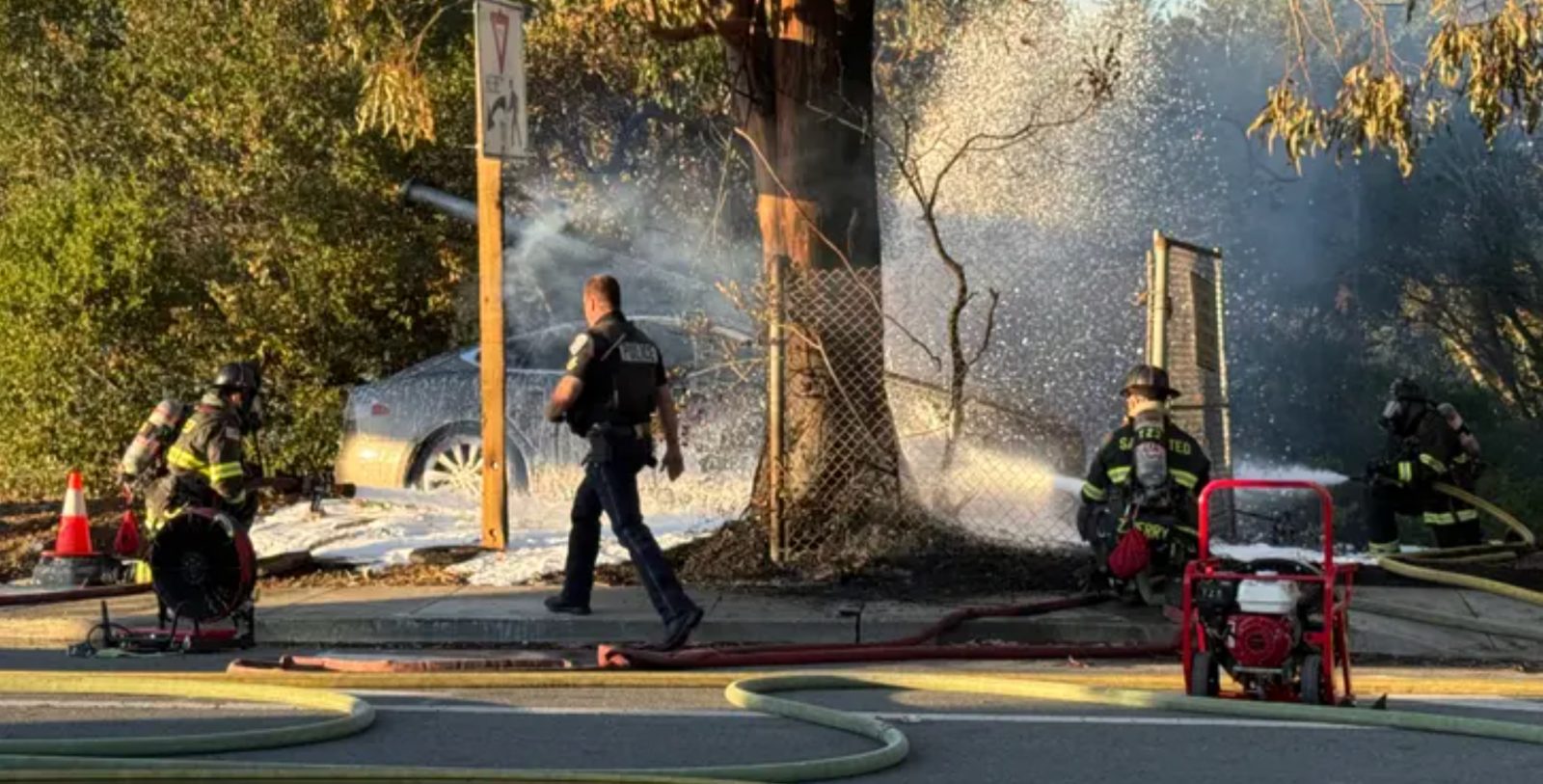
San Mateo, California. On July 15, a 2016 Tesla Model S left the road, struck a light pole, and caught fire, killing its driver. Tesla’s report: driver-assist verified engaged, 52 mph, a solo strike of a fixed object. It’s a road departure, the single most common crash type in Tesla’s entire driver-assist file.
Ione, California. Around 7:18 a.m. on July 22, a Tesla heading north on Highway 104 crossed into the southbound lane, sideswiped a Honda, and hit a Cadillac head-on, according to the California Highway Patrol. The Tesla’s driver, Shelby Waldie, 25, was killed; a 2-year-old in the car was hospitalized. Investigators said the reason it crossed the center line is under investigation. Tesla’s report: a brand-new 2026 Model Y, verified engaged, 54 mph. The reason it crossed is the redacted narrative.
Ashby, Minnesota. Around 3:57 p.m. on July 20, on Interstate 94 in a work zone, a westbound Ford collided with an eastbound Tesla, and a third vehicle then struck them, the Minnesota State Patrol said. Two people died: the Tesla’s driver, Harold Ennulat, 73, and the Ford’s driver, 24. Here, the police made it sound like the Ford was going the wrong way, so the engaged Tesla was likely not to blame. But Tesla’s data still shows the system on at 50 mph, and Tesla holds the EDR and the video.
None of the four was reported publicly as involving Autopilot or FSD. In each, the only reason anyone can connect the death to a driver-assist system is that Tesla had to file a report, which it then redacted.
Tesla’s own count is low
There’s a second problem buried in these filings. Tesla’s report lists a single “highest injury severity.” In Upper Marlboro, three people died, and in Ashby, two did, yet each report records one fatality. Tesla’s federal filings undercount the dead in its driver-assist crashes, which means every aggregate built from this data, including safety comparisons Tesla itself points to, starts low.
Why the redaction matters
Almost no other automaker does this. GM runs a comparable connected-fleet system in Super Cruise and redacts none of its crash narratives. Across the current file, Tesla hides the narrative on 100% of its reports; GM, 0%.
This is the heart of the investigation. Tesla is, more than ever, pushing owners to treat a Level 2 driver-assistance system as if it drives itself, selling the software as “Full Self-Driving” while the human stays legally responsible at all times. Then it seals the records that would show how the system behaves when things go wrong, telling regulators it would “suffer financial harm” if the public saw them. A motorcyclist, a rideshare passenger, a 25-year-old with her toddler in the car, a 73-year-old man: four people dead in one month, in cars Tesla’s own data says were driving themselves, and not one of those reports says what the car did.
Electrek’s Take
We’ve now matched more than a dozen of these, one by one, from Clute to Moraine, and July made the point in a single month: as the crash count climbs to record highs, the fatal cases keep surfacing in Tesla’s data and staying out of the public record. Some of these deaths, like the Minnesota one, may not be Tesla’s fault at all. That’s exactly why the narratives should be open, because right now no one outside Tesla can tell the difference between a crash the system caused and one it didn’t.
We’re careful about the claim. A system being engaged within 30 seconds of a crash doesn’t prove it caused the crash, and the redacted software field means we can’t even separate Autopilot from FSD. But that uncertainty is Tesla’s doing. It has the data, it filed the reports, and it decided that what its cars did in four fatal crashes is a trade secret. Tesla is already under NHTSA investigation over how it reports these crashes. Until the narratives open up, we’ll keep matching them.
Even in the Minnesota crash, which I conceded might not sound like Tesla is at fault, the data and crash narrative might still be useful. Maybe the driver was on FSD, not paying attention, and could have avoided or mitigated the crash if they were.
If you’re driving a Tesla, powering it with home solar is one of the cheapest ways to cut your fuel costs to almost nothing. With electricity rates up almost 10% last year and expected to keep climbing, going solar is one of the best ways to protect yourself against rising costs. And with lease and PPA options, you can do it with zero upfront cost and start saving immediately. If you want to find the best deal, check out EnergySage. It’s a free service with hundreds of pre-vetted installers competing for your business, so you save 20 to 30% compared to going it alone. No sales calls until you pick an installer. Get your free quotes here.


FTC: We use income earning auto affiliate links. More.




Comments